Showing posts with label Metal Protector. Show all posts

Friday, April 12, 2013

John Deere Attachments (Dethatcher)

Let me tell you up front - dethatching is not glamorous.  I know that's hard to believe but it's true.  But it's a necessary part of taking care of your lawn.  And like my John Deere Lawn Sweeper, which I talked about in my last post, my John Deere Dethatcher does what it's designed to do and it does it well.  I'll get into the dethatcher details in this post. 


First of all, why should you dethatch your lawn?  Thatch is the layer of built-up plant material between the green top growth and the roots of your grass.  Thatch develops naturally as lawn grasses grow and shed roots, shoots and leaves. Some thatch helps protect the roots, but too much thatch prevents water, oxygen and nutrients from getting through to the soil.  You can help avoid thatch build-up by mowing frequently so that the blades of grass are smaller and will decompose more quickly.  Grass clippings contain nutrients that are good for your grass, including the nutrients that you've already applied through fertilizer.  I always try to dethatch before I apply fertilizer so that the fertilizer better penetrates to the roots.  And I always dethatch before the grass is actively growing just because it's easier for the dethatcher to get through the grass without building up on the tines, although technically it could be done anytime during the season.

The other reason that I use my John Deere Dethatcher is the moss in my lawn.  The yard has lots of trees both throughout, creating lots of shady spots.  That, combined with the moisture and humidity and the clay soils that we have here in the south, provides the perfect environment for moss to thrive.  If moss is allowed to grow unchecked, it will simply take over, which I've allowed it to do in certain areas where I didn't really want grass anyway.  Although moss is green and soft (and cuddly) and actually looks good in the right locations, moss and grass just don't mix.


The John Deere Dethatcher is an outstanding tool for removing both thatch and moss although once the moss is removed, seeding with a shade tolerant grass seed is critical since the moss will always come back if the ground is left bare.  It sometimes seems like a never ending battle but it does give me an excuse to use my dethatcher (got to think positive!).

The first step is to make sure that the dethatcher is heavy enough to scrape up the moss and thatch  without just bouncing along the ground behind the tractor.  Loading it up with several bricks does the trick.  And since the grass is not long this time of year, I set the dethatcher at the lowest level so it scrapes fairly deep (if the grass is high, setting it too low will just clog up the tines, turning a "not so bad job" into a "really horrible job" as you jump off the tractor every five minutes to clear off the tines).  

Dethatcher Ready to Go!
Moss in the Yard

Moss after Dethatching
More Moss after Dethatching

 The dethatcher works great on thatch as well (my kids would tell me "duh" but it really works well): 


After a few passes with the dethacher, there's loads of moss and thatch that should not be left lying on the grass thereby defeating the whole purpose for all that hard work riding around on the tractor.  So with another excuse to use my John Deere Lawn Sweeper, I sweep up what's been removed.  It's heavy stuff and there's lots of dumping involved, but the sweeper handles it extremely well.  


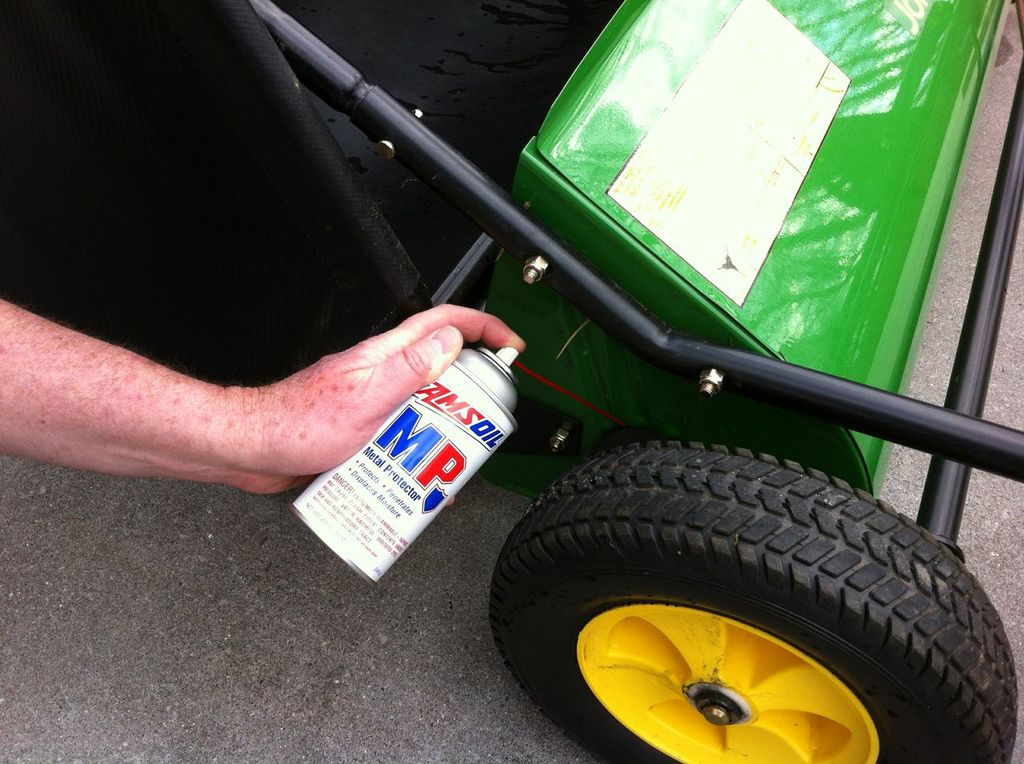
As with the sweeper, once the job is done it's time to clean off the dethatcher.  It gets pretty dirty and muddy and the bricks bouncing around tend to wear off the paint creating some bare metal spots.  AMSOIL Metal Protector (MP) (AMSOIL Product Code AMP) is the ideal product to use after rinsing and before putting up the dethatcher for the season.  AMSOIL MP does an outstanding job protecting against rust and providing lubrication where there's metal to metal contact.  

AMSOIL MP Metal Protector (old packaging)
AMSOIL MP Metal Protector (new packaging - same great formula)

AMSOIL MP is an easy-to-use spray-on product that protects metal surfaces, displaces water and silences squeaks.  It lubricates metal surfaces, leaving a dry wax-like film, doesn't form gum or sludge and it's compatible with plastic, fabric and paint.  The greatest thing about it is that it doesn't leave a film that attracts dust or dirt so I just spray it on and leave it.  In all the years that I've been washing down and protecting my equipment, I've never had any rust or corrosion problems while using AMSOIL MP.  It certainly provides piece-of-mind to an equipment junky like me.  Even better, when it's time to use the equipment again, I know that it's lubricated and ready to go.  You won't believe how many uses you can think of for AMSOIL Metal Protector!


Thanks for visiting this post.  We'll talk about fertilizing the lawn with AMSOIL's AGGRAND Natural Based Fertilizer using my Northstar Sprayer (from Northern Tools and Equipment) in the next post.

Questions, comments and advice are always welcome!!


Wednesday, April 10, 2013

JOHN DEERE ATTACHMENTS (Lawn Sweeper)

Yeah, I'm that guy in the neighborhood who you love to hate, the one working in the yard, striving for the greenest grass, plucking weeds as soon as they appear and yelling at kids to "get off my lawn."  Well, maybe that's an exaggeration (I don't really yell at kids to get off my lawn) but I do like to have nice green grass and I don't really like spending all of my free time doubling as my own yard service.

There are a couple of things that I do, however, that any lawn service would typically perform in the spring: picking up sticks/debris that have accumulated over the winter and dethatching the lawn.  The way I figure it, I could (1) do it by hand, which would take hours of backbreaking work; (2) pay someone to do it, which would require me to use my money (earned through hours of backbreaking work); or (3) I could make a one-time investment in the equipment necessary to do the job minus the backbreaking part and in the end have the equipment and be money ahead.  Plus, I get to use my John Deere lawn tractor for more than just mowing the grass, helping to fulfill my fantasies of being a farmer.  So I invested in a John Deere Lawn Sweeper and a John Deere Dethatcher to go with my John Deere LA175 tractor.  I'll talk about the John Deere Lawn Sweeper in this post. 


Portions of my yard contain large trees which, with certain exceptions I like.  The Sweet Gum trees, common in the Southeast, really get on my nerves.  Don't get me wrong, the Sweet Gums are large, beautiful trees (especially in the fall), they're fast growing and provide great shade.  Unfortunately, they also provide me with thousands of "gumballs" during the late winter and spring.  If you've never seen a "gumball" you're not missing much.  Gumballs are spikey hard balls containing thousands of seeds that prevent you from walking barefoot in the grass without extreme pain.  They drop like rain and cover the ground under the trees and tend to roll to low spots in the lawn where they congregate.  Sweet Gum trees are also weak and routinely drop large sticks and branches onto the grass.  If you try and ignore the gumballs, they just accumulate, make your yard look like crap and get smashed into the grass where they are almost impossible to get out.  I initially tried raking them but ended up fighting a never-ending battle (although my forearms became absolutely massive).  But with the John Deere Lawn Sweeper, the gumballs have finally met their match!


Obviously the sticks, gumballs, acorns and other detritus built up in the lawn over the winter should be removed since a heavy accumulation of debris will smother the grass and create bare areas.  The John Deere Lawn Sweeper is perfect for this task and makes my life much easier.  I've found that it's best to do this job before the grass starts growing; if the grass is too long, the gumballs (and the other stuff) gets caught in the grass and won't sweep up as well.  Plus it's tougher for the sweeper brushes to get down into that thicker grass.  This year I got an early start, the grass was very low and I was able to set the sweeper at the lowest level allowing it to collect lots of debris.  As you can see, after a few passes I collected lots (and lots, and lots) of gumballs, sticks, leftover leaves, etc.  Although the contents of the sweeper were quite heavy and I had to dump it frequently, the sweeper is well designed making it easy to dump just by pulling the ropes attached to the top of the sweeper.  


How well the sweeper works can be seen by the results (as a yard guy, I absolutely love this machine - I don't know what I did without it):


Once I've completed the spring sweeping jobs (which includes picking up the thatch that I'll talk about in the next post), I always like to clean my equipment before putting it up, especially when it's going to sit for awhile which my sweeper does.  The sweeper gets dusty and dirty and although it probably wouldn't be a big deal if I just stuck it in the garage, no matter how hard I try I can't bring myself to do that (knowing how dirty it was would keep me up at night).  So I always wash it down before putting it up.


Although you might be thinking that spraying equipment down with water is a bad idea and will lead to rusty parts, I don't worry about my equipment rusting for a couple of reasons.  First, I dry off the areas that I can reach.  Second, I use AMSOIL Metal Protector (MP) (AMSOIL Product Code AMP) on any area where metal touches metal (all of the joints and pivot points).

AMSOIL MP Metal Protector (old packaging)
AMSOIL MP Metal Protector (new packaging - same great formula)
 AMSOIL MP is an easy-to-use spray-on product that protects metal surfaces, displaces water and silences squeaks.  It lubricates metal surfaces, leaving a dry wax-like film, doesn't form gum or sludge and it's compatible with plastic, fabric and paint.  Unlike WD-40, it dries without leaving any sticky residue so dirt won't stick to it.  In all the years that I've been washing down and protecting my equipment, I've never had any rust or corrosion problems while using AMSOIL MP.  Even better, when it's time to use the equipment again, I know that it's lubricated and ready to go.  I really love this stuff! 


Thanks for visiting this post.  I'll discuss the John Deere Dethatcher in the next post.

Questions, comments and advice are always welcome!!

Thursday, March 28, 2013

JOHN DEERE MAINTENANCE (Part 1 - Chassis Lubrication)

Although it's been colder than normal here in North Carolina, the trees are starting to bud, the daffodils are blooming and, the grass is just starting to grow (at least on the sunny side of the house where the septic tank is).  But all of it's going to be growing soon so in preparation, I performed some spring maintenance on my John Deere LA175 lawn tractor that I want to share with you.

I bought the tractor in the spring of 2010 and it has about 165 hours on it now.  I picked the John Deere because of its reliability, it's power and maneuverability, the comfortable seat (important for an old dude like me) and because it also has a bunch of attachments that go with it that kind of function as big-boy toys.  Maybe it goes back to when I was a kid in Illinois where we lived in the country, surrounded by corn and soybeans, where the farmers were always on their tractors doing something out in the fields.  So climbing on my tractor allows me to relive my childhood, or maybe it's just fun to drive, but either way I enjoy using the tractor for all sorts of work around our yard.  I must say that it's been a workhorse for the last three years, performing all sorts of chores with no problems. 

I first wanted to mention equipment storage.  Since I'm much smarter now than I was in the fall (thanks to viewing training videos on the AMSOIL dealer website), I really should have done all of this maintenance before putting my tractor away for the winter.  Had I done that, the tractor would not only have already been ready for the mowing season, it would also have been better protected during winter storage.  Luckily, AMSOIL products help ensure that all of your outdoor equipment is properly protected even if you neglect to do perform the maintenance in the fall like I did.  I'll cover equipment storage in a later post.  

My John Deere LA175

First, lubrication.  Since I hate screwing stuff up, I tend to follow the John Deere Operator's Manual when I do my maintenance.  John Deere recommends certain John Deere greases including "a general all-purpose grease with an NGLI grade rating No. 2 rating."  I use AMSOIL Synthetic Multi-Purpose Grease NGLI #2 (AMSOIL product code GLC) because (1) it complies with the John Deere recommendations; (2) the performance properties of AMSOIL Multi-Purpose Grease exceed those of the recommended John Deere greases (and it's compatible with those greases); and (3) it's what I have in my grease gun for use in my vehicles anyway so I don't have to worry about having two different grease guns or changing out cartridges (a job I hate).   

AMSOIL Synthetic Multi-Purpose Grease provides the following performance features:
  • Resists thermal and oxidation degradation
  • Provides excellent water-washout resistance
  • Outstanding low-temperature pumpability and torque value
  • Adhesive and shear stable to prevent squeeze out
  • Excellent load-carrying and EP performance
What this translates to for tractor owners is that components resist wear and corrosion better,  your equipment lasts longer, components stay cleaner and dryer, your equipment performs better and requires fewer repairs.  For a buck or so more than the John Deere greases (using AMSOIL preferred customer pricing) the AMSOIL Synthetic Multi-Purpose Grease is a fantastic deal for those looking for the best performance and longest equipment life possible (which includes me since I hate spending my hard-earned cash buying new stuff when the old stuff works just fine - drives my wife crazy sometimes though). 

AMSOIL Synthetic Multi-Purpose Grease

There are several grease points on the LA175.  Here they are:

Wheel Spindle Grease Fitting (2)

Wheel Hub Grease Fitting (2)

Front Axle Center Pivot Grease Fitting

Spindle Grease Fittings (3)

Note that John Deere recommends lubricating your tractor every 25 hours of operation.  

In my opinion, if metal parts touch each other they should be lubricated at least once-in-a-while (to use a technical term).  Except for deck idler pivot which John Deere recommends be sprayed with a "general all-purpose spray lubricant," the Operator's Manual doesn't mention providing any additional lubrication to the tractor.  However, given my obsession for ensuring optimal performance and equipment longevity, my maintenance routine includes using a spray lubricant at various points on the tractor.  For this job I use AMSOIL MP Metal Protector (AMSOIL product code AMP), a spray-on lubricant that protects metal surfaces, displaces water, silences squeaks and lubricates metal surfaces, leaving a dry wax-like film that's not sticky. What I love about MP is that it dries clean, dirt doesn't stick to it, it does not form any gum or sludge and is excellent at preventing rust and corrosion (I've actually got a thousand uses for this stuff but I'll spare you the details - once you use it I'm sure you'll build your own list).  
AMSOIL MP Metal Protector (old packaging)
AMSOIL MP Metal Protector (new packaging - same great formula)

Here are few of the places I spray my tractor.  Like I said if metal touches metal, I spray it.  So go crazy with the MP!
  Steering Linkages
 
 "Stuff" Underneath
 
Pedal Mechanisms

Deck Wheels

I could go on but you get the idea.  AMSOIL MP has worked for me not only on this tractor but on all of my other lawn and garden equipment, not to mention a bunch of other things around the house.


That does it for lubrication.  Thanks for visiting this post.  We'll tackle engine maintenance next.  


Questions, comments and/or advice are always welcome!!