Although I hesitated based on the size of the yard (about 2+ acres of grass), I ultimately found the right tool for the job and that was the NorthStar 26-gallon Tow-Behind Sprayer from Northern Tool + Equipment. Being a John Deere guy, I really wanted the John Deere Tow-Behind Sprayer which, based on my internet research, was a good piece of equipment. However, since I lean to the cheap side, the price ($520) was more than I wanted to pay. So I did some more research and found good reviews on the NorthStar sprayer. Since there was a Northern Tools store that recently opened nearby, I decided to check it out. I liked what I saw and ended up buying one mid-season for $279 (on sale with a $20 coupon). I then cancelled my TruGreen service and started using my sprayer.
Be aware that you will have to assemble the sprayer. Despite what you may read in some on-line reviews about how difficult assembly is, my 20-something son and daughter put it together (correctly) within about 2 hours. It's really not that hard if you just read and follow the directions.


Weed and Crabgrass Killer Application
When we got back from vacation, crabgrass and other weeds had basically taken over our lawn (like I said, despite TruGreen's pre-emergent application). The sight almost brought me to tears but once I dried my eyes the first thing I did was try to find a reasonably priced weed killer that would also kill the crabgrass. However, all I could find at the big box stores was the 32 oz bottles of Bayer, Ortho and other common brands that only cover 5,000 square feet. Given the size of my lawn I would have needed at least 10+ bottles. So thinking like a farmer, I visited my local Tractor Supply store and picked up three one-gallon bottles of Gordon's Trimec Crabgrass Plus Lawn Weed Killer Concentrate for $29.95 each. A gallon covers 20,000 square feet. The Trimec kills over 200 different types of weeds plus it kills crabgrass. And, the best part is, it actually works!
 |
| Trimec Crabgrass Plus Lawn Weed Killer |
The hardest part about using the tow-behind sprayer is making sure that the application rate is correct, especially when using weed killers. You really don't want to kill or maim your grass by applying too much but you want to apply enough to kill the weeds/crabgrass. The application rate is a combination of the amount mixed per gallon of water, the rate at which the sprayer applies the mixture and the speed at which you drive. I mixed the Trimec in my sprayer in accordance with the directions on the bottle (2.5 oz per gallon covering 400 square feet). Now you can get really technical about this which I initially tried to do. If you look at the very last page of the sprayer Owner's Manual, you will find tables which show application rates. Using the gallons/1000 square feet table you can try and figure out the speed at which you need to drive. This is a pretty inaccurate science since there is no speedometer on the John Deere LA175 lawn tractor. So I enlisted the help of my son and we roughly figured speed based upon the amount of time it took to travel 100 feet. I don't really know what exactly the speed was but believe me, it was very sloooooooow! Once I knew approximately what speed that I needed to travel, I mentally sectioned off my lawn into thirds and used a tank per section using the 2.5 oz/gallon mix rate. Having gone through all of that, if you mix it at the recommended rate and drive slow, you should be ok. I must have done something right because my lawn was fine and the crabgrass and weeds were dead.
Fertilizer Application
Many people who know about AMSOIL don't know that AMSOIL has a separate division, AGGRAND, which offers a line of natural and organic fertilizers. I've always used chemical fertilizers on my lawn and TruGreen did the same. While the chemicals worked fine, the lawn would always look a little greener after the applications, but the green faded over time until the next application. Plus, there were times that I wondered whether the fertilizer was even working at all since I didn't see any results. And I always thought in the back of my mind that some of whatever I was applying would eventually end up in a lake or river somewhere. While I'm not an environmental activist by any stretch, I like to do the right thing when it comes to minimizing environmental impacts if possible.

AGGRAND Natural Fertilizer 4-3-3 (AGGRAND Product Code NOF) is a multipurpose liquid concentrate formulated to promote vigorous growth, increased root development and improved stress and disease tolerance on flowers, vegetables, fruits, lawns, shrubs, trees, field crops and houseplants. AGGRAND Natural Fertilizer uses kelp concentrate which accumulates high levels of potassium which increases plant health by enhancing heat, drought and cold tolerance. It's made from oceangoing menhaden fish that feed on mineral-rich plankton (Native Americans have used menhaden for centuries as a natural fertilizer). Menhaden provides nitrogen, phosphorus, potassium, 10 essential micronutrients and numerous vitamins and amino acids.
While menhaden fish emulsions and kelp provide the basis for AGGRAND Natural Fertilizer, additional ingredients help achieve a balanced analysis:
- Sulfate of Potash - Extremely fine-grade natural mineral derived from the Great Salt Lake increases potassium levels.
- Bloodmeal - Boosts availability of nitrogen in slow-release form to provide this vital nutrient as the plant requires it.
- Natural Wintergreen Oil - Improves scent of AGGRAND Natural Fertilizer.
 |
| AGGRAND Natural Fertilizer 4-3-3 |
Since the season began, I've made two applications of AGGRAND Natural Fertilizer using my NorthStar sprayer. Based on the size of my lawn, I ordered two 2.5 gallon bottles of fertilizer, which, at a mix rate of 32 oz. per 8 gallons of water per 1000 square feet, is enough for three applications. The application rate depends upon your speed which you will have to figure based upon the tables in the sprayer owner's manual. To be honest, I didn't pay as much attention to the tractor speed with the fertilizer as with the weed killer since applying too much is not as much of a concern.

To mix the fertilizer, I use a 24-oz mixing cup (available in the paint department of Lowe's). I mix enough for 20 gallons. The fertilizer has a thick consistency so I first put some water in the sprayer tank, add the correct amount of fertilizer for 20 gallons (80 oz/20 gal.) and fill the tank to a little over the 20-gallon mark to account for the fertilizer. This mixes the fertilizer well, important since I don't have an agitator in my tank (the fertilizer will settle if you let it sit too long). I start fertilizing shortly after mixing since the motion keeps the fertilizer sufficiently mixed to avoid clogging. Be aware - the fertilizer has an odor. Well, that may be a little understated - it smells bad (which I figure is good when it comes to fertilizer). Since I know what it's made of, it doesn't really gross me out (it's just dead fish), but be prepared for the smell.


 |

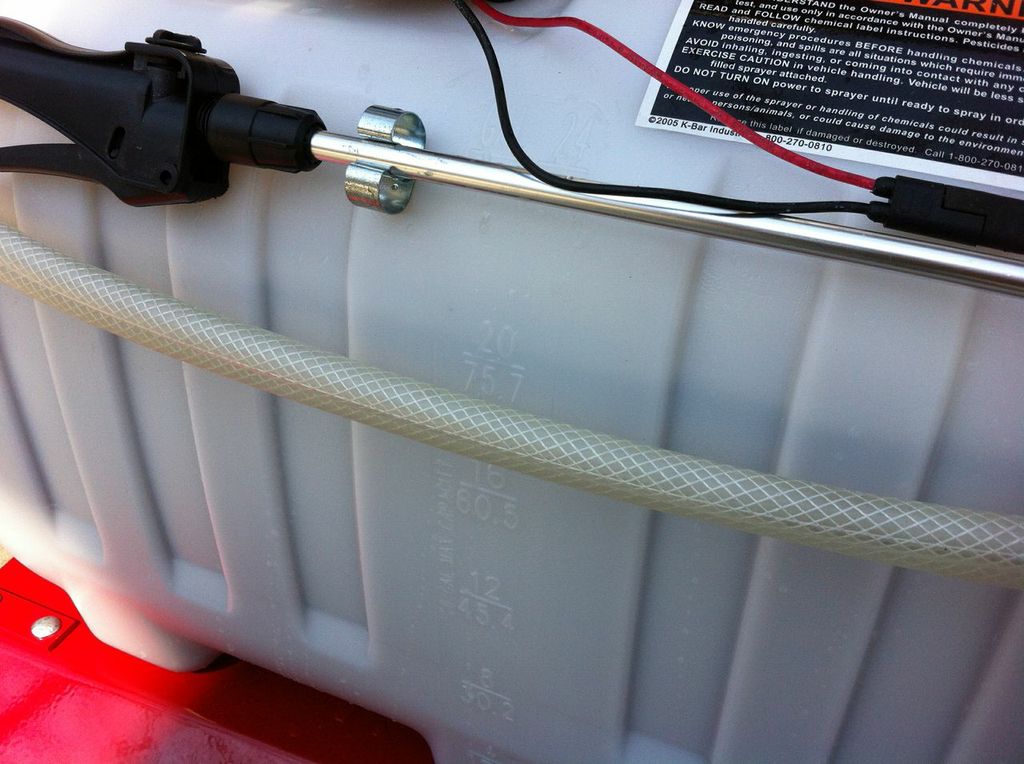
Hooking up the sprayer is easy. Just connect the wires from the pump up to the battery on the tractor, making sure the positive and negative wires are connected to the correct battery terminals. The wire is plenty long enough to reach the battery with the switch running along the side of the tractor. There's a rocker switch that ends up by your right foot which allows you turn the sprayer on and off while in use - a convenient feature.


To operate, just turn the switch to "on" when you want to spray and turn it off when you reach an area you don't want to spray (it does take a few seconds for the pressure to relieve so it will continue to spray for a bit after you turn it off). Make sure that the booms are down, the nozzles pointed down and the valves in the open position. There's also a sprayer wand attached to the tank. It's a great tool for getting into corners, spraying bushes and spraying the garden. Turning off the nozzle valves provides more pressure to the wand.


I always clean my equipment when I'm done. I rinse the tank and then run clean water through both the nozzles and the wand. I also spray off and wipe down the external parts, especially those near the back since those get a fine coating of fertilizer on them when in use. When all done, the tank is clean with no residual fertilizer (or smell) in the tank.


One last thing involves taking care of the wheels. Many on-line reviewers indicated that they had problems with the wheels not being secure or coming off in operation. While I attribute much of that to operator error, it made me take extra precautions with the wheels. First, make sure that the wheel retainers are securely fastened. In addition, I use AMSOIL Spray Grease on the wheels. AMSOIL recently reformulated it spray grease. The new AMSOIL Spray Grease (AMSOIL Product Code GSP) is a lithium grease that effectively reduces friction and wear, keeping components running clean and trouble-free for outstanding performance and long life. It applies quickly and evenly and is ideal for greasing hard-to-reach equipment, including hinges, springs and other common applications. Instead of the Spray Grease, you could also use AMSOIL Metal Protector (MP) (AMSOIL Product Code AMP), a spray-on lubricant that protects metal surfaces, displaces water, silences squeaks and lubricates metal surfaces, leaving a dry wax-like film that's not sticky. MP dries clean, dirt doesn't stick to it, it doesn't form any gum or sludge and is excellent at preventing rust and corrosion.
 |
| AMSOIL Spray Grease |
 |
| Spraying AMSOIL Spray Grease (old formulation) |
 |
| AMSOIL (MP) Metal Protector (old packaging) |
 |
| AMSOIL MP Metal Protector (new packaging - same great formula) |
Although the AGGRAND Natural Fertilizer takes some time to work, sometimes even over a season, the following pictures show progress between the two applications, about a month apart.
 |
| Lawn Following Application 1 |
 |
| Lawn Following Application 2 |
 |
| Lawn Following Application 1 |
 |
| Lawn Following Application 2 |
 |
| Lawn Following Application 1 |
 |
| Lawn Following Application 2 |
UPDATE: Summer has passed and it's now the middle of October. Since the Spring, I've continued to apply AGGRAND fertilizers. In late Spring I applied a second treatment of AGGRAND Natural Fertilizer 4-3-3 and a third treatment in early fall. In addition, in late summer I applied a treatment of AGGRAND Liquid Lime (AGGRAND Product Code NLL), an easy and effective alternative to bagged lime designed for use on permanent ground covers such as lawns, pastures and hay fields. The Liquid Lime features finely ground limestone in a liquid suspension that can be absorbed by leaves and roots and provides much needed calcium to promote superior plant growth. I mixed 32 oz per 10 gallons of water and drove slowly over the lawn with the sprayer using one 2.5 gallon jug for 50,000 square feet of lawn.
 | |
| AGGRAND Liquid Lime |
The results of my efforts over the summer were AMAZING!! Although the lawn was green before, following the application of the Liquid Lime, the color turned a deep, lush green. Another thing that I noticed was a lack of weeds throughout the summer (with the exception of an infestation of crabgrass that again took hold while we were on vacation). Normally, TruGreen would have sprayed at least twice for weeds over the course of the season. Using the AGGRAND natural products, I had zero weeds although I did spray for crabgrass a couple of times using the Trimec Crabgrass Killer (again using the sprayer). The crabgrass died and left some bare spots but I've aerated and overseeded so those should fill in nicely. Here are the results of my efforts over the season; the grass now rivals that of the best lawns in the neighborhood. Not too shabby for a DIY effort!


Thanks for visiting this post!
Questions, comments and advice are always welcome!!


